How to Prepare Form T1134: Controlled Foreign Affiliate with FAPI - Part 2

In Part 1 of this series, we worked through Form T1134 using a relatively simple example: a Canadian resident individual owned 100% of a U.S. corporation that was a manufacturer. The U.S. corporation carried on an active business and, for purposes of the example, did not earn any foreign accrual property income, or FAPI.
In Part 2, we will change the facts.
Instead of an operating company, our foreign corporation will own and rent US real estate. This gives us an opportunity to look more closely at the portions of Form T1134 dealing with a controlled foreign affiliate ("CFA") that earns FAPI.
We will also modify the Canadian shareholder in our example. In Part 1, the foreign affiliate was owned by a Canadian resident individual. In this example, the foreign affiliate will instead be wholly owned by a Canadian corporation. The CFA will also make a distribution to Canco during the year, allowing us to consider how a distribution affects Form T1134 reporting.
Importantly, this example illustrates an important distinction:
T1134 is not simply an information reporting form. If a CFA earns FAPI, the Canadian shareholder may also have a current Canadian income inclusion even if the foreign corporation does not distribute any cash.
Section 91(1) generally requires a Canadian resident taxpayer to include its participating percentage of a CFA's FAPI in income.
Facts:
CanCo ("Taxpayer") is a Canadian-controlled private corporation ("CCPC"). Taxpayer is wholly owned by a Canadian resident individual.
CanCo is a holding company and has a December 31 year end.
The Taxpayer was not involved in a section 85, 85.1(3), 86.1, 87, nor 88 transactions during 2025.
The Taxpayer has not filed Form T106 for 2025.
The Taxpayer owns 100% of DEF Company, a corporation resident in the US ("USCo"). DEF Company is not an LLC and is liable for corporate tax in the US.
USCo owns and operates a residential rental property in the state of Florida.
USCo has a December 31 year end.
USCo was incorporated on July 1, 2023. On incorporation, Taxpayer subscribed for 100 common shares for $1,000,000. This represents all of the issued and outstanding shares of USCo.
USCo did not earn FAPI nor incur FAPL or FACL in 2023 and 2024.
USCo is not considered dormant for the purpose of 2025 Form T1134 filing.
USCo's FAPI for 2025 is calculated as $50,000.
USCo's foreign accrual tax applicable to the above FAPI is $10,000. CanCo will claim 91(4) deduction of $19,000 in 2025.
In January 2025, USCo made a distribution of $300,000. There were no exempt, hybrid nor taxable surplus immediately prior to the dividend payment. No US withholding tax applied on the distribution.
No 91(5) deduction is claimed with respect to the distribution above.
Assume that the Canadian and US dollars are at par at all times.
USCo has also made an advance of $100,000 to CanCo during 2025. This amount has been repaid during the first half of 2026.
USCo does not own any shares in any other foreign affiliate of the Taxpayer.
USCo has not disposed of any capital property during 2025.
USCo did not employ any full time employees during 2025.
The Taxpayer has filed Form T1134 in respect of the USCo in 2023 and 2024.
USCo's 2025 Income Statement is below.

**The T1134 forms shown below are completed using entirely fictitious information and are provided for illustrative purposes only. They are not intended for filing with the CRA.**
Page 1

Page one is straightforward and requires basic information about the Taxpayer.
Page 2 - 5
Pages 2 - 5 would be the same as the Form T1134 example in Part 1.
Page 6

Page 6 begins with basic information about USCo.
USCo would be a foreign affiliate ("FA") and a controlled foreign affiliate ("CFA") of the Taxpayer. For discussion of the rules surrounding FA and CFA, refer to this article.
Page 7

The Taxpayer is the sole shareholder of USCo. The ACB is adjusted as follows:
ACB as of January 1, 2025: $1,000,000
Add:
FAPI amount of $50,000 under 92(1)(a) of the Canada's Income Tax Act ("ITA").
Deduct:
91(4) deduction of $19,000 under 92(1)(b) of the ITA;
$300,000 of distribution prescribed to be paid out of pre-acquisition surplus under 92(2) of the ITA.
ACB as of December 31, 2025: $731,000.
Page 8

USCo has advanced $100,000 to CanCo during 2025 which is outstanding as of December 31, 2025.
Remaining questions are beyond the scope of this article but in the current scenario, answer would be generally 'No'.

Foreign affiliate dumping rule should generally not apply as CanCo is not controlled by a non-resident or a group of non-residents. Foreign affiliate dumping rules are beyond the scope of this article.
Page 9

Given that USCo is a CFA of the Taxpayer, financial statement of USCo needs to be attached to the Form T1134.

Given that the taxpayer is a Canadian corporation, the surplus regime is relevant.
When a distribution is not prescribed to be paid out of exempt, hybrid or taxable surplus, the distribution is prescribed to be paid out of pre-acquisition surplus. Generally, a Canadian corporate taxpayer is entitled to deduct the portion of the distribution prescribed to have been paid out of pre-acquisition surplus under 113(1)(d) of the ITA.
Pre-acquisition surplus is technically not a surplus balance that one tracks like other surplus accounts. However, international tax practitioners generally view pre-acquisition surplus as ACB of the shares of FA given that distribution paid out of pre-acquisition surplus reduces the ACB pursuant to 92(2) of the ITA.
If ACB becomes negative, it may result in a capital gain to the recipient under 40(3) of the ITA.
It is also important to note that generally, any pro-rata distribution to shareholders by a FA (including a return of capital) are deemed to be dividends under 90(1) and 90(2) of the ITA. Exceptions apply.
Page 10


CanCo would be a specified debtor and has received $100,000 from USCo during 2025. However, provided that the loan is repaid within two years of the day it was made, and the repayment is not part of a series of loans or other transactions and repayments, subsection 90(8)(a) should prevent the loan from being included in CanCo's income under subsection 90(6).
Page 11

Answers to all of the questions in this page are 'No'.
Page 12

Page 13
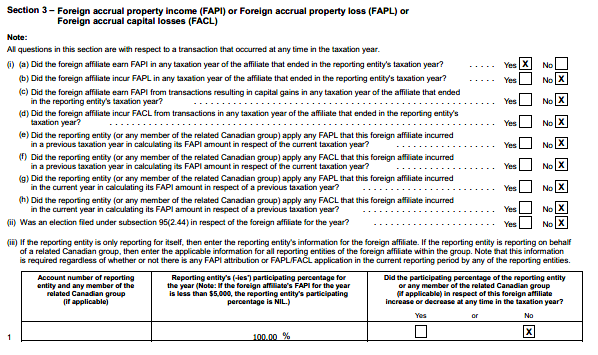
For purposes of this example, we have assumed that USCo has FAPI of $50,000. It is important to note, however, that determining FAPI is a separate Canadian tax calculation and the amount will likely not correspond to the income reported on the CFA's financial statements or US tax return.
Broadly, the CFA's relevant income and deductions must be determined under Canadian income tax principles and generally in Canadian dollars. For example, because USCo earns rental income from real estate, the FAPI calculation would require consideration of capital cost allowance ("CCA") under the Canadian tax rules. The resulting CCA deduction may differ from both the depreciation expense recorded for financial statement purposes and the depreciation deduction calculated under US tax rules.
Page 14


Final Thoughts
Form T1134 is often thought of primarily as an information reporting form. However, where a CFA earns FAPI, the Canadian tax consequences can extend well beyond the filing of the form itself.
As this example illustrates, a Canadian taxpayer may be required to include FAPI in its income even where the CFA has not distributed the underlying earnings. This makes it important to distinguish between the amount reported as FAPI on Form T1134, the resulting income inclusion under subsection 91(1), and any available deduction for foreign accrual tax.
The analysis does not necessarily end there. When the CFA makes distributions to its Canadian corporate shareholder, the foreign affiliate surplus and FAPI rules must also be considered to determine the Canadian tax treatment of the distribution.
For Canadian taxpayers with FAs and CFAs, preparing Form T1134 is therefore only one part of the exercise. Proper FAPI calculations, foreign tax tracking, surplus and ACB calculations can be equally important.
Warm regards,
Francis Do, CPA, CA
Have any questions? Please contact Francis Do at Francis@francisdo.com or 416-572-9633.
Disclaimer: This article is not intended to be a tax advice. Always consult and verify with a tax professional.


Comments